Donald Trump Takes His Case on the Economy to North Carolina in a High-Stakes Speech
- Dec 20, 2025
- 4 min read
20 December 2025
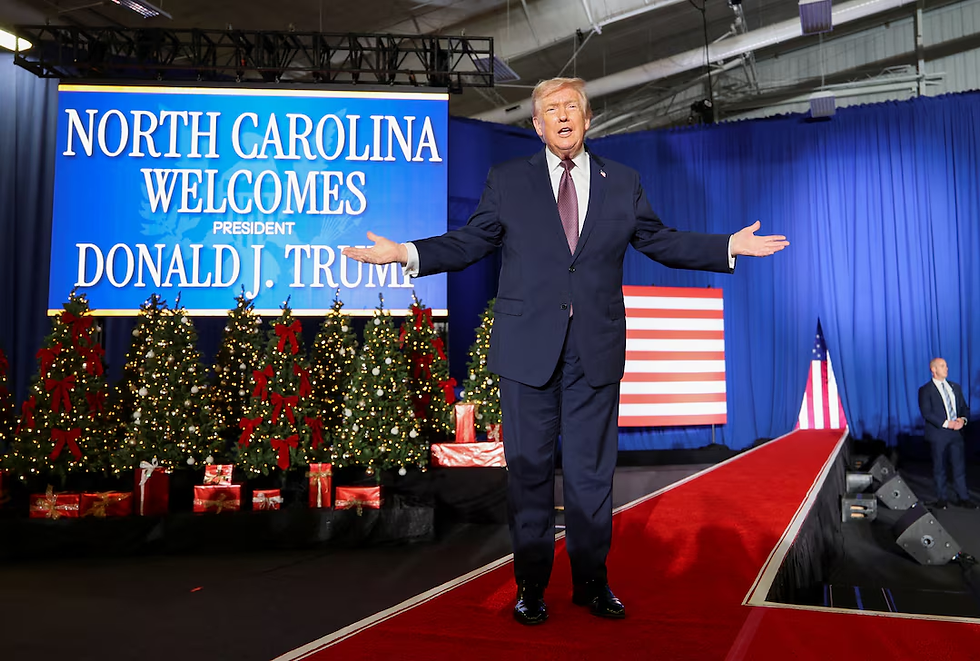
On a brisk December evening in Rocky Mount, North Carolina, U.S. President Donald Trump stepped onto the stage not just for a political appearance but for what his aides and supporters hope will be a defining moment in his second term, a chance to fundamentally reshape how voters perceive the economy heading into the pivotal 2026 midterm elections. With inflation still a concern for many Americans, wages not keeping pace with rising costs and unemployment stubbornly higher than when he took office, Trump’s speech was more than a campaign-like rally; it was an extended appeal aimed at convincing ordinary citizens that his economic policies have laid the groundwork for a resurgence, that brighter days lie ahead and that his leadership is essential for sustained growth and prosperity.
For nearly 90 minutes, the president traveled through a litany of talking points, praising gains in stock markets, touting lower-than-expected inflation figures and highlighting a high-profile deal to reduce prescription drug costs, all of which he insisted were direct results of his administration’s actions. Speaking to a crowd in a state that has been competitive in recent elections, Trump argued that the economy is poised on the brink of a boom and that any current struggles are a direct consequence of Democratic obstruction and mismanagement. “This achievement alone should win us the midterms,” he declared of the pharmaceutical cost-cutting agreement, underscoring his belief that economic narratives could be the key to bolstering Republican fortunes next year.
Yet the speech also laid bare the challenges Trump faces. A Reuters/Ipsos poll released this week showed that only 33 percent of U.S. adults approve of the way he has handled the economy, a figure that highlights a significant disconnect between White House messaging and public perception. Despite the president’s insistence that gas and certain consumer prices have fallen and that tariff policies are generating billions for the U.S. Treasury, many Americans remain unconvinced that their personal economic situations have materially improved. Critics point to persistent inflation in sectors like housing, food and energy, and to wages that have not kept pace with cost increases, and they argue that everyday experiences of economic stress are out of sync with the rosy picture the administration portrays.
Inside the White House, advisers say the timing of the North Carolina event was deliberate. The president’s trip to the battleground state served as both a policy address and a political signal that the GOP intends to make the economy its central issue for 2026, betting that emphasizing growth, tax cuts and regulatory rollbacks will resonate with voters anxious about job security and household finances. Trump’s itinerary before returning to his Mar-a-Lago resort for the holidays underscores how tightly intertwined governance and political strategy have become in his approach to leadership.
But outside the carefully staged event center, sentiment among ordinary North Carolinians paints a more complicated picture. In communities like Rocky Mount, residents express a mix of skepticism, hope and frustration. Some acknowledge small improvements — for instance, a modest decrease in gas prices or the perception of encouragement for local businesses — but also report continued hardship when it comes to affording groceries, rent and healthcare. These contradictions suggest a broader national mood in which Americans are not entirely ready to embrace a narrative of robust economic recovery, even as official statistics show pockets of progress.
Republicans themselves are not monolithic in their response. While many in the party remain staunchly behind the president’s messaging, others quietly acknowledge that simply reciting economic metrics may not be enough to win over voters who feel economically squeezed. The concern among GOP strategists is that inflation and unemployment could become defining issues that not only undercut Trump’s standing but also jeopardize Republican control of both the House and the Senate. In a political landscape where control of Congress will shape the final years of Trump’s presidency, these stakes loom large.
Democrats have seized on the opportunity to highlight these vulnerabilities. Party leaders have pointed to lingering economic anxieties as evidence that Trump’s policies have fallen short, and they are using North Carolina and similar battleground states as platforms to argue for alternative approaches that emphasize worker wages, healthcare affordability and targeted support for struggling families. Their narrative seeks to reinforce the notion that economic leadership should be judged not on abstract statistics but on tangible improvements in everyday life.
Throughout his speech, Trump reiterated his long-standing belief that the U.S. economy is stronger with his policies in place and that critics overlook the progress made under his leadership. He framed his comments as a corrective to what he describes as a media landscape that underreports positive economic news and overemphasizes negativity, a theme that resonated with his core supporters. Yet for many observers, the broader challenge remains convincing the undecided and economically anxious majority that their personal experiences align with the president’s claims.
As 2025 draws to a close and the nation enters what could be a contentious midterm cycle, the North Carolina speech stands as a defining moment in Trump’s effort to frame the economy as a winning issue. Whether this effort will translate into political success or further underscore the divide between political rhetoric and public reality remains to be seen, but what is clear is that economic perceptions will continue to be central to American political discourse in the months ahead.


Comments