U.S. Job Growth Slows Sharply in December Even as Unemployment Eases
- Jan 10
- 4 min read
10 January 2026
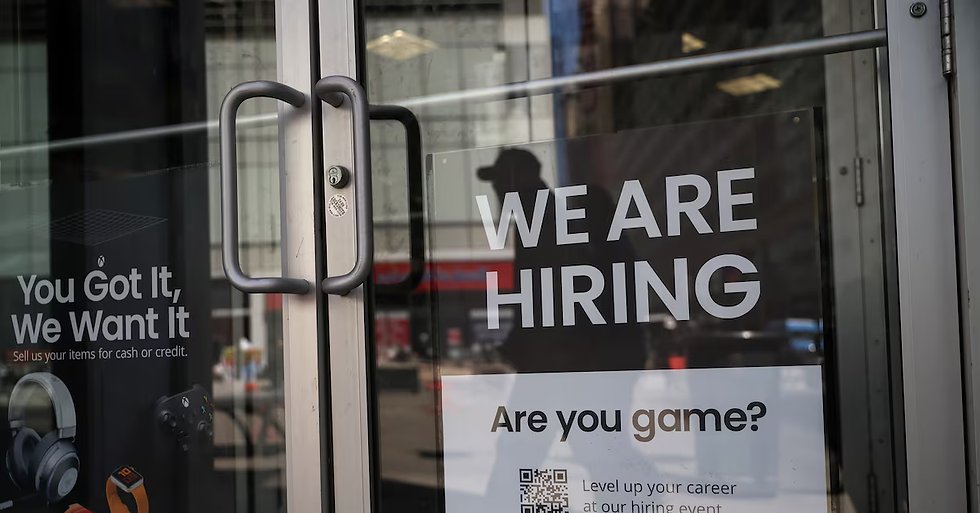
In the last employment report of 2025, the U.S. labor market revealed a complex story of slowing hiring tempered by a modest decline in joblessness, offering a nuanced snapshot of economic conditions heading into 2026. According to statistics released by the Labor Department, nonfarm payrolls increased by just 50,000 jobs in December, a pace markedly weaker than economists had anticipated and down from a revised 56,000 gain in November. This slowdown in hiring illustrates the challenges facing employers and underscores broader shifts in business behavior around staffing and investment. At the same time, the unemployment rate eased to 4.4 percent, down from 4.5 percent in November, hinting that the labor market remains resilient even as momentum falters.
What stands out in the most recent employment figures is the contrast between tepid job growth and the falling unemployment rate. On the surface, the dip in joblessness suggests that fewer Americans were actively seeking work, a pattern that can occur when discouraged workers stop looking or when slower hiring is balanced by other labor force dynamics. Although a lower unemployment rate is generally welcomed by policymakers, economists caution that it does not necessarily signal robust labor market health when job creation remains subdued.
The December jobs report also highlighted sector-specific trends that reveal where the economy is gaining traction and where it is losing ground. Job gains were concentrated in service-oriented industries that have traditionally supported overall employment growth. The leisure and hospitality sector expanded, adding tens of thousands of positions as restaurants and bars continued to hire. Healthcare payrolls also rose, with most gains occurring in hospitals and clinics, reflecting ongoing demand in this essential industry. Social assistance likewise contributed to hiring, albeit at a level well below its average monthly gains in 2025.
In contrast, several cyclical sectors saw employment decline in December. Retail payrolls shrank, reflecting challenges in consumer spending patterns and inventory adjustments at major chains. Manufacturing also shed jobs, a continuation of pressures that have dogged the sector for months as global competition, automation and tariff-related cost concerns weigh on production. Construction employment was down as well, suggesting that broader economic caution is leaching into industries that are sensitive to interest rates and investment cycles.
Wages, however, showed modest strength. Average hourly earnings increased on a year-over-year basis, helping to support consumer spending even in the face of slowing hiring. Wage growth at the national level has remained healthy relative to historical trends, bolstering household incomes for many workers, though inflation-adjusted gains remain a point of debate among economists. Solid wage increases can contribute positive momentum for consumer demand even when job creation is weak, but they also complicate the Federal Reserve’s inflation calculus.
Economists and policymakers have interpreted the December employment data through the lens of broader labor market dynamics. Many analysts describe the current environment as a jobless expansion, a period in which economic output grows without strong corresponding job gains. Factors cited for this pattern include cautious corporate hiring practices, heightened automation and artificial intelligence investment that can substitute for labor, and the lingering impact of aggressive trade and immigration policies that have restrained both labor supply and demand. These elements contribute to a labor market that is neither overheated nor in clear decline, but marked by uncertainty and structural change.
The Federal Reserve watches jobs data closely because it informs monetary policy decisions, particularly around interest rates. The modest pace of hiring alongside a slightly lower unemployment rate complicates the central bank’s outlook. On the one hand, slower job growth suggests reduced pressure on wages and prices. On the other hand, solid wage gains and a still-resilient unemployment rate give the Fed little reason to implement aggressive rate cuts. In December 2025 the Fed trimmed its benchmark interest rate to a range of 3.50 percent to 3.75 percent, but officials indicated they were likely to pause further reductions while assessing incoming data and its implications for inflation and growth.
Industry reaction to the jobs figures reinforced this cautious stance. Bond markets and stock indexes showed muted responses as investors weighed the implications for interest rates and economic momentum. Treasury yields fluctuated in the aftermath of the release, reflecting uncertainty about the pace of future Fed action. The dollar also experienced modest gains against foreign currencies, driven in part by expectations that the Fed would maintain its current stance rather than pursue immediate rate cuts.
Some labor market watchers also pointed to changes in how employment statistics are calculated. The Bureau of Labor Statistics annually revises certain models it uses to estimate job gains and losses, particularly in how it accounts for business openings and closures. These methodological adjustments can influence how headline numbers are interpreted, especially in a period when job growth is already modest. Additionally, broader revisions to historical data, to be incorporated in upcoming reports, may further change perceptions of the labor market’s strength over recent years.
Another noteworthy element of the December report was the ongoing decline in hiring activity relative to earlier periods. Over the course of 2025, monthly job creation averaged far below levels seen in previous economic expansions, reinforcing the narrative that employers are operating in a mode of “no hire, no fire,” where layoffs are limited but new hiring is also restrained. This pattern contributes to a labor market that feels stable but sluggish, with few signs of a dramatic acceleration in payroll gains.
The broader economic context also plays into interpretations of the jobs report. Global uncertainties, tariff disputes, supply chain adjustments and rapid technological change have all shaped business investment decisions and hiring practices. In such an environment, workers and employers alike are adjusting to a landscape where growth is uneven across sectors and regions. While areas like tech and healthcare continue to expand, traditional manufacturing and customer-facing retail roles have faced persistent headwinds.
As the labor market enters 2026, policymakers, business leaders and workers will continue to scrutinize employment trends for signals about economic resilience, inflation pressures and future interest rate policy. The December jobs report, with its mix of slow growth and a lower unemployment rate, captures the ambiguity of the moment and highlights the delicate balance between caution and confidence shaping decisions at every level of the economy.
In the end, the U.S. employment landscape at the close of 2025 reflected a labor market that has shifted into a more measured phase, one where growth is present but restrained, and where the relationship between jobs, wages and economic policy remains at the forefront of national discussion.


Comments